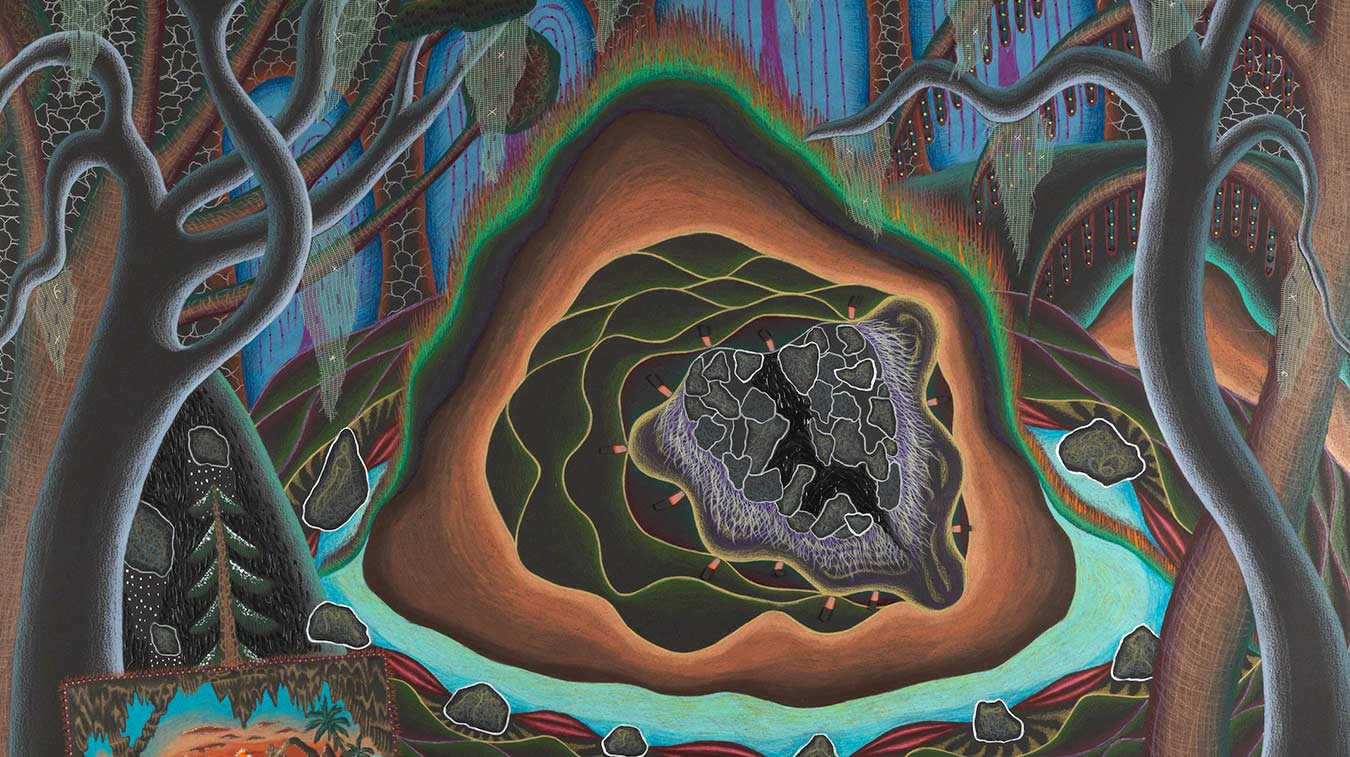
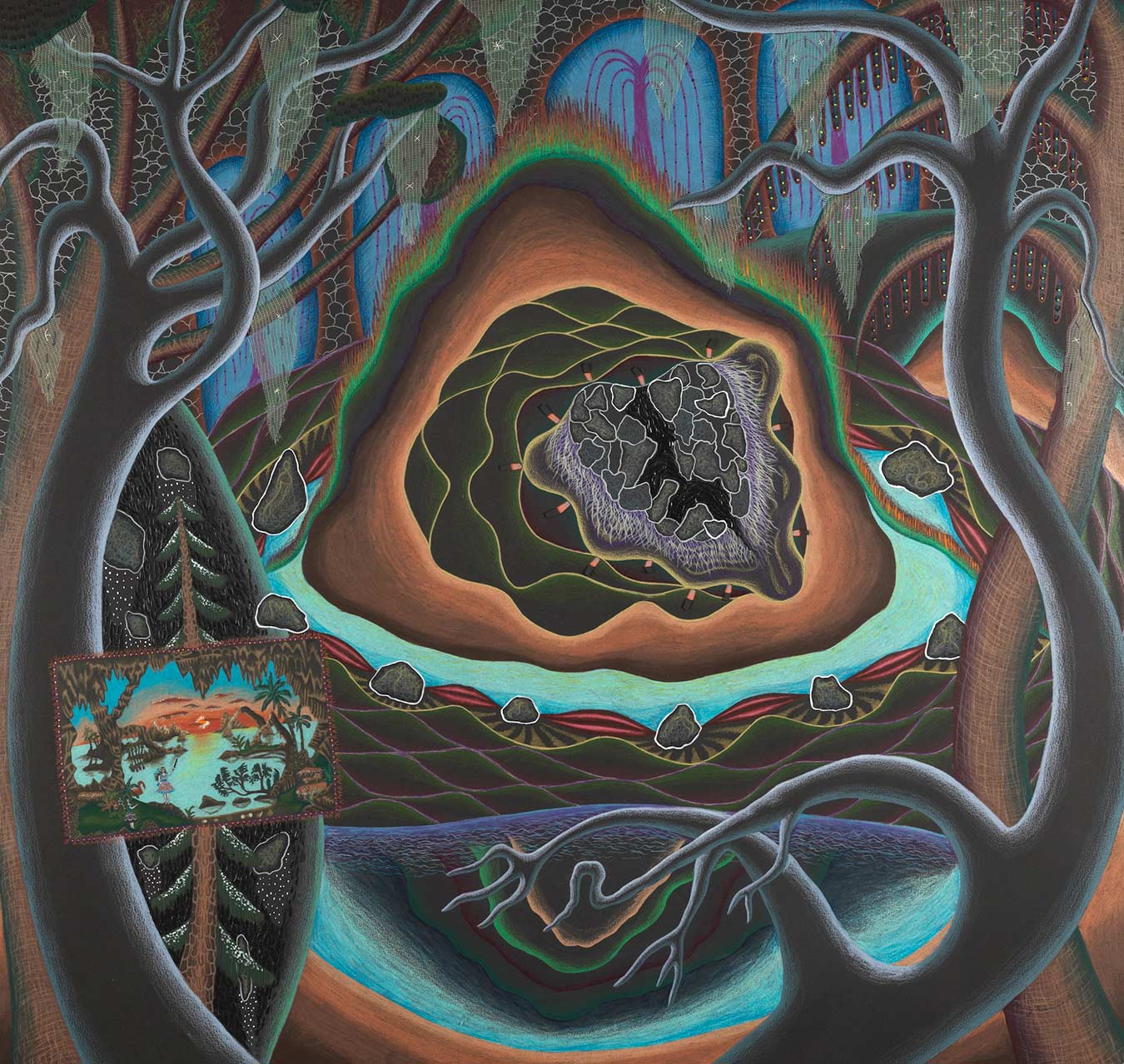
Telfair Museums presents:
Off the Coast of Paradise: Artists and Ossabaw Island, 1961–Now
This spring, Telfair Museums presents Off the Coast of Paradise: Artists and Ossabaw Island, 1961–Now, the first major exhibition to explore the profound impact of an undeveloped, 26,000-acre barrier island off the coast of Savannah, Georgia, on artists working in the United States. Opening on March 13 and running through September 6 at The Jepson Center for the Arts at 207 West York Street in Savannah, the exhibition features the work of 32 artists who have considered the island through historical, environmental, social, cultural, and personal lenses over the last 65 years.
The exhibition focuses on the Ossabaw Island Project (OIP) and Genesis—a pair of revolutionary multidisciplinary residency programs that ran on the island from 1961 to 1982—and their legacies in its examination of Ossabaw as a site for creative experimentation. Taking its name from a poem written by celebrated poet and Genesis member Henri Cole, Off the Coast of Paradise features the work of Harry Bertoia, Agnes Denes, Marcy Hermansader, Suzanne Jackson, Ellen Lanyon, Doris Lee, Jack Leigh, Sally Mann, Michael Mazur, Ross McElwee, Athena Tacha, Betty Tompkins, and Anne Truitt, among many others, as well as a major new commission by Allison Janae Hamilton.
“While the Ossabaw Island Project was operating at the level of such legendary residencies as Yaddo and MacDowell by the end of its twenty-one-year run, it remains little known today,” said curators Erin Dunn and Beryl Gilothwest. “Off the Coast of Paradise aims to bring this important history to the fore, not only revealing how Ossabaw has been a sanctuary for artists, but also how it has profoundly influenced them.”
Spanning painting, sculpture, drawing, photography, film, and textiles, among other media, the works in Off the Coast of Paradise are drawn from public and private collections around the United States. The exhibition traces how a diverse range of American artists have grappled with nature, identity, environmentalism, spirituality, and race in the context of Ossabaw’s unique natural and cultural histories. The show also considers how the residency programs that ran on the island from the early 1960s to the early 1980s facilitated the production of work that is both deeply specific to Ossabaw and resonant on an international stage.
Telfair has commissioned Allison Janae Hamilton to create a new film for the exhibition, to be screened nightly on the façade of Telfair Museums’ Jepson Center. Drawing on her own experience as a Black Southerner, Hamilton engages with the history of enslavement on Ossabaw through the lens of marronage in Venus of Ossabaw (2026). After her protagonist, Venus, escapes from a plantation on the island and makes her way down Georgia’s coast to Spanish Florida, she faces a choice in terms of her freedom. She can either join the Catholic church in Saint Augustine or remain with the maroons who helped her along the way.
Off the Coast of Paradise: Artists and Ossabaw Island, 1961–Now is organized by Erin Dunn, Curator of Modern and Contemporary Art at Telfair Museums, and Beryl Gilothwest, Guest Curator and Deputy Director of Research and Exhibitions at Calder Foundation, New York.
Exhibition Overview – Off the Coast of Paradise
Organized thematically, Off the Coast of Paradise invites visitors to move through immersive galleries that evoke the myriad ways artists have engaged with Ossabaw Island over the last 65 years. In 1961, Ossabaw’s co-owner, Eleanor “Sandy” Torrey West, and her husband, Clifford B. West, established a multidisciplinary residency program known as the Ossabaw Island Project (OIP). Unlike similar programs such as Yaddo in Saratoga Springs, New York, and MacDowell in Peterborough, New Hampshire, that were tailored towards artists only, the Wests invited intellectuals in the sciences, linguistics, history, mathematics, law, religion, and other disciplines to Ossabaw in addition to painters, photographers, sculptors, writers, musicians, and other artists. Residents were given the opportunity to work on projects of their choosing and to gain inspiration from the island’s wild and majestic environment. In 1970, the Wests expanded their program to include Genesis, a cooperative, semi-sustainable community oriented towards younger and less established residents.
Sandy West often described Ossabaw as “a catalyst,” believing that the island would speak to those who approached it with patience, flexibility, and ample time. In 1961, the powerful natural forces at play on Ossabaw’s beaches inspired mid-century master Harry Bertoia to develop an entirely new method of casting bronze, which he dubbed “spill casting,” for a major commission at Dulles International Airport in Washington, D.C. He continued using the same technique in a series of standing works over the ensuing years, two of which are featured in Off the Coast of Paradise. For many of the visual artists who participated in the Ossabaw Island Project, Genesis, or who visit Ossabaw today, the island acts as a conduit to fresh ideas and new ways of thinking.
The show continues with a section dedicated to artists who have engaged directly with Ossabaw’s terrain. The island’s landscape contains multitudes, a mixture of dense maritime forest, flat sand beaches, and endless expanses of marsh. It is as beautiful as it is dangerous, with poisonous snakes, alligators, and swarms of mosquitoes appearing when you least expect them. The contradictory nature of Ossabaw’s terrain, eluding straightforward interpretation, is catnip for many of the visual artists who explore the island. The Boston-based painter Michael Mazur came to the Ossabaw Island Project in January 1975 with the specific aim of conjuring the island’s landscape in a new body of work. The island remained a focus for years after he left, resulting in a series of monumental drawings and paintings that evoke the all-encompassing and often foreboding reality of Ossabaw’s forests.
Ossabaw’s rare beauty and unvarnished wildness cannot be fully experienced without understanding its complex human history. The island has both a rich cultural heritage and a legacy of violence, displacement, and enslavement. Many visual artists who have spent time on Ossabaw have engaged with this paradox in their work, often considering the island through the lens of a broader American experience. During her weeklong visit in 2010, the painter Suzanne Jackson was drawn to the Gullah Geechee and Indigenous spirits that she perceived in Ossabaw’s trees. In the gestural swathes of watercolor in Jackson’s paintings, the island’s oaks take on new forms that hew closer to an otherworldly realm.
More than 50 years after her parents purchased the island as a winter retreat, Sandy West and her brother’s children conveyed Ossabaw to the State of Georgia in 1978. In a landmark act of environmental preservation, West worked with Georgia governor Jimmy Carter to establish the island as the state’s first Heritage Preserve “…to protect, conserve, and preserve the natural and cultural resources of this Island for the benefit of present and future generations.” Today, the non-profit Ossabaw Island Foundation manages access under the Heritage Preserve’s stipulation that Ossabaw “shall only be used for natural, scientific, and cultural study, research, and education, and environmentally sound preservation, conservation, and management of the Island’s ecosystem.” Ultimately, Ossabaw Island’s known history and influence reverberate far beyond its physical shores. Off the Coast of Paradise offers one lens through which to explore the island’s continuous and powerful pull.
Catalogue
Off the Coast of Paradise is accompanied by a lavishly illustrated scholarly publication that complements the exhibition and takes an in-depth look at the history of Ossabaw Island during the 20th century. The book considers the island in the context of the artists who spent time there, providing a rich understanding of a little-known place with lasting significance on a national scale. By challenging what we think we know about American residency programs over the last century, this volume shines a light not only on how artists used Ossabaw to retreat from their lives and concentrate on their work, but also on it as a wellspring of creative experimentation. A series of essays and remembrances reveals how various aspects of the island enabled artists to reconnect art to the American landscape, beginning during a period of rapid postwar transformation. This publication also features an expansive chronology that highlights the evolution of the Ossabaw Island Project and the Genesis programs, as well as their legacies. Off the Coast of Paradise: Artists and Ossabaw Island, 1961–Now is published by Telfair Books.
Exhibition Support
Major support is provided by the Teiger Foundation and the Henry Luce Foundation. Production support for Venus of Ossabaw by Allison Janae Hamilton is provided by VIA Art Fund. Publication support is provided by the Frances and Beverly DuBose Foundation, Inc. Exhibition investment is provided by the City of Savannah. Support through Telfair’s major exhibition fund is provided by Bob Faircloth and Linda McWhorter. Annual exhibition support is provided by Director’s Circle Council Members: Mrs. Cynthia Willett, Leslie and Angus Littlejohn, Mr. and Mrs. Steven J. Sayer, Mr. and Mrs. Alan Sheriff, Mrs. Inge A. Brasseler, Kerry and Lillian Breitbart, Mr. Robert F. Faircloth, Mr. and Mrs. Ronald J. Gantt, Ms. Lori Judge, Pamela and Marek Lewanda, Wilson Morris, Thomas V. and Susan G. Reilly, Cathy and Philip Solomons, Mr. and Mrs. Austin P. Sullivan Jr., Pamela L. and Peter S. Voss, Ms. Susan A. Willetts, and Mr. Alan K. Pritz. Additional support by Lisa White.
About Telfair Museums
Opening in 1886, Telfair Museums is the oldest public art museum in the South and the first U.S. museum founded by a woman. The museum features a world-class art collection in the heart of Savannah’s National Historic Landmark District and encompasses three sites: the Jepson Center for the Arts, the Owens-Thomas House & Slave Quarters, and the Telfair Academy. For more information on Telfair Museums, please visit www.telfair.org.
About Ossabaw Island
At approximately 26,000 acres, Ossabaw Island is Georgia’s third-largest barrier island, located 30 minutes south of Savannah on the Atlantic coast. Nearly 9,000 acres are high ground; the remainder are tidal wetlands. The island is roughly ten miles long and 7 miles wide at its widest point. Ossabaw is bordered by the Atlantic Ocean to the east, the Bear River and Florida Passage of the Intracoastal Waterway to the west, the Ogeechee River and Ossabaw Sound to the north, and St. Catherine’s Sound to the south. Ossabaw Island is a Heritage Preserve owned by the State of Georgia. The Department of Natural Resources (DNR) manages the island, and the Ossabaw Island Foundation maintains several island buildings and coordinates on-island programming. For more information on Ossabaw Island, please visit www.ossabawisland.org.
March 13 – to September 6, 2026 | Jepson Center
Discover more:
https://www.telfair.org/exhibitions/off-the-coast-of-paradise-artists-and-ossabaw-island/
Follow on Instagram: @TelfairMuseums