An Exclusive Interview With Erin Hanson
The Poetry of Light
Open Impressionism
Landscape & Nature Oil Painting
© All rights reserved
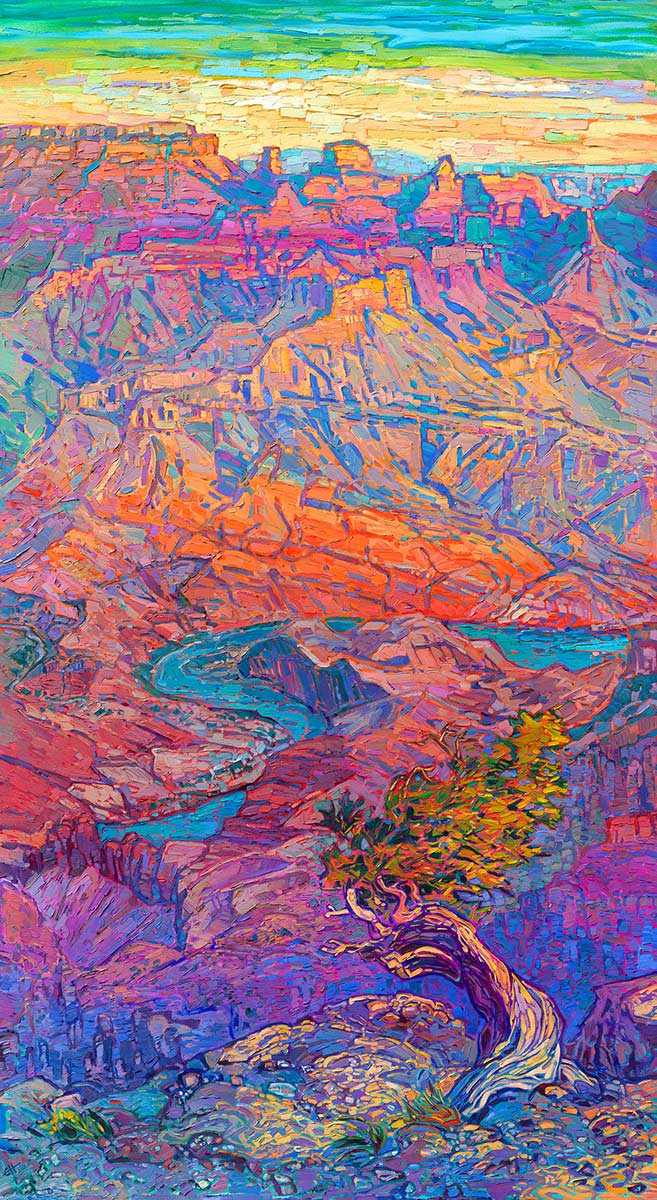
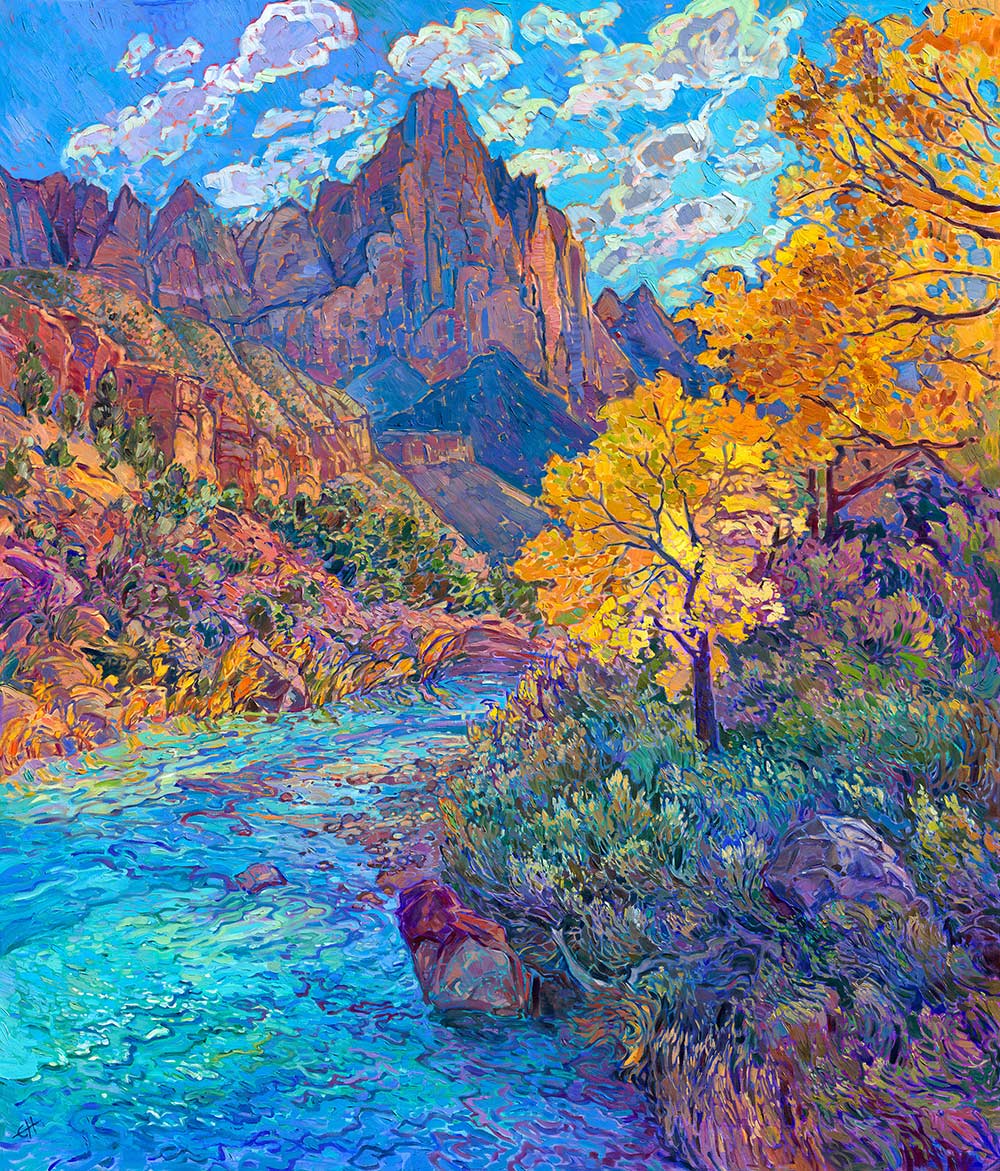
Right: “Grand Canyon Light”. 2022
Oil on canvas, 189 x 101 cm
Erin Hanson © All rights reserved
“I aim to capture the beauty of light during the golden hour and transform ordinary landscapes into extraordinary mosaics of color and texture.
I apply oil paint in thick, expressive brushstrokes laid side by side, without blending, in the style I coined Open Impressionism.”
– Erin Hanson
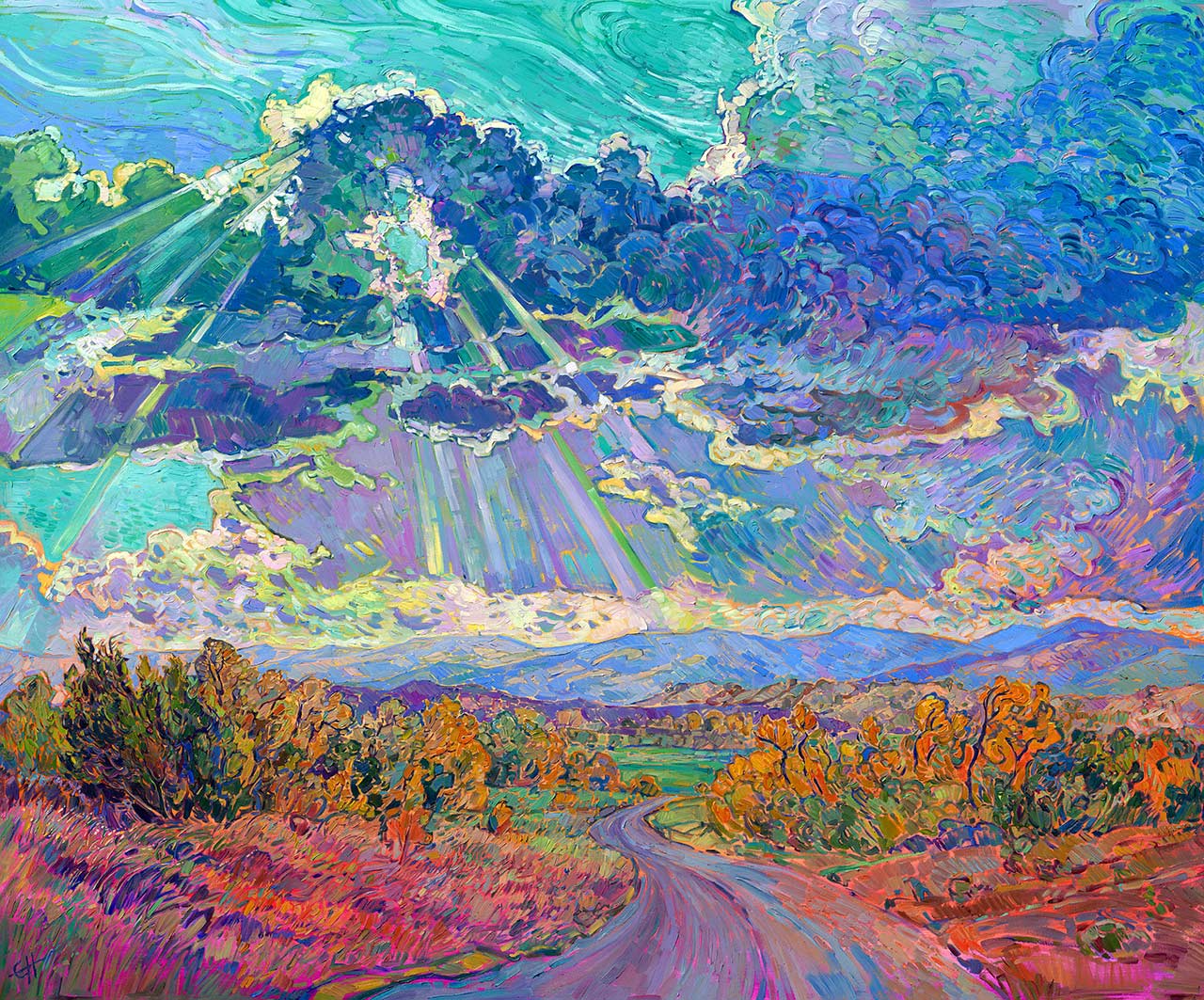
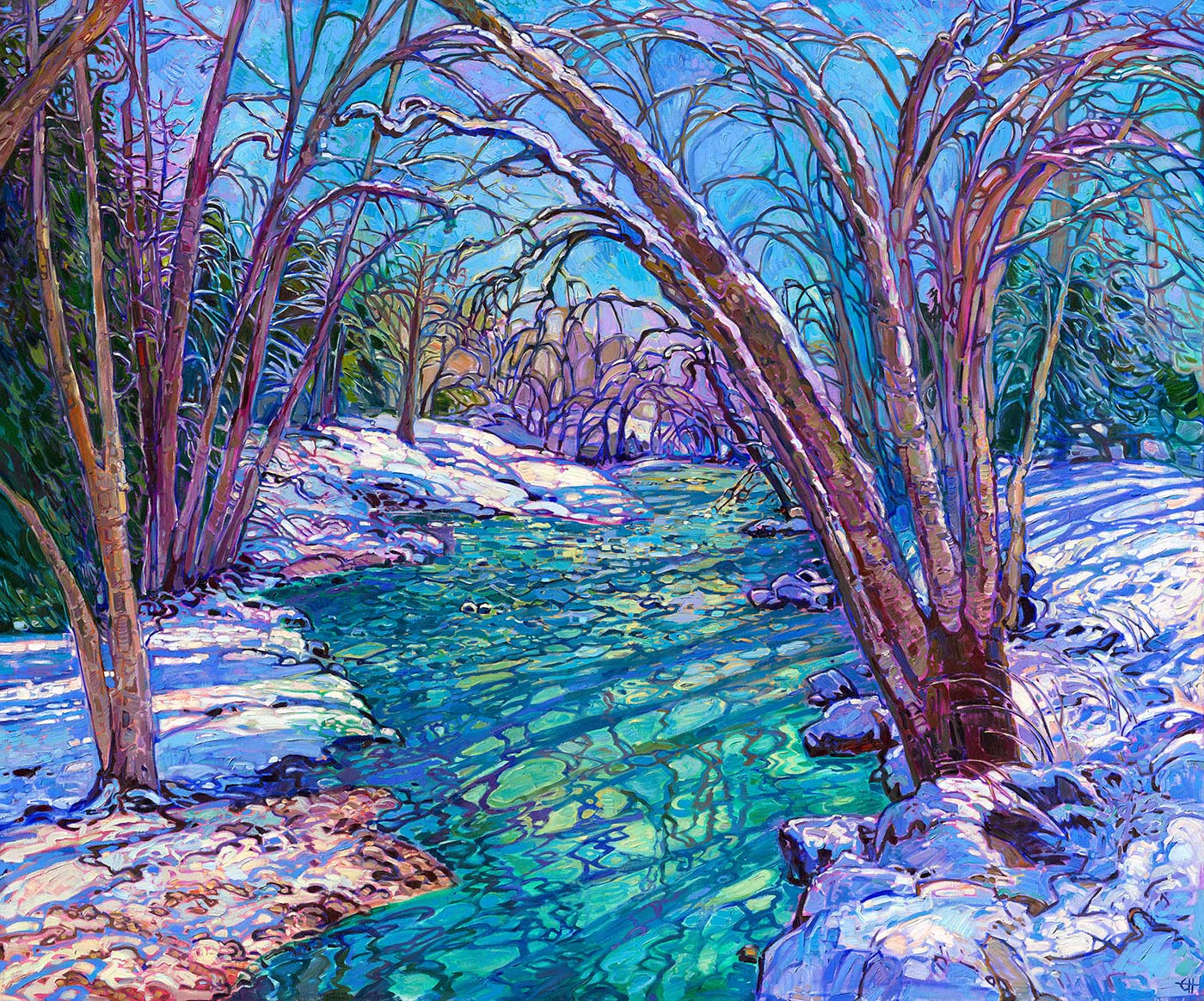
Oil on canvas, 178 x 213 cm
Erin Hanson © All rights reserved
“With each painting I begin, I have fresh hope of creating a piece that stops other people in their tracks and makes them feel the same emotional joy I felt when I first saw the landscape.”
– Erin Hanson
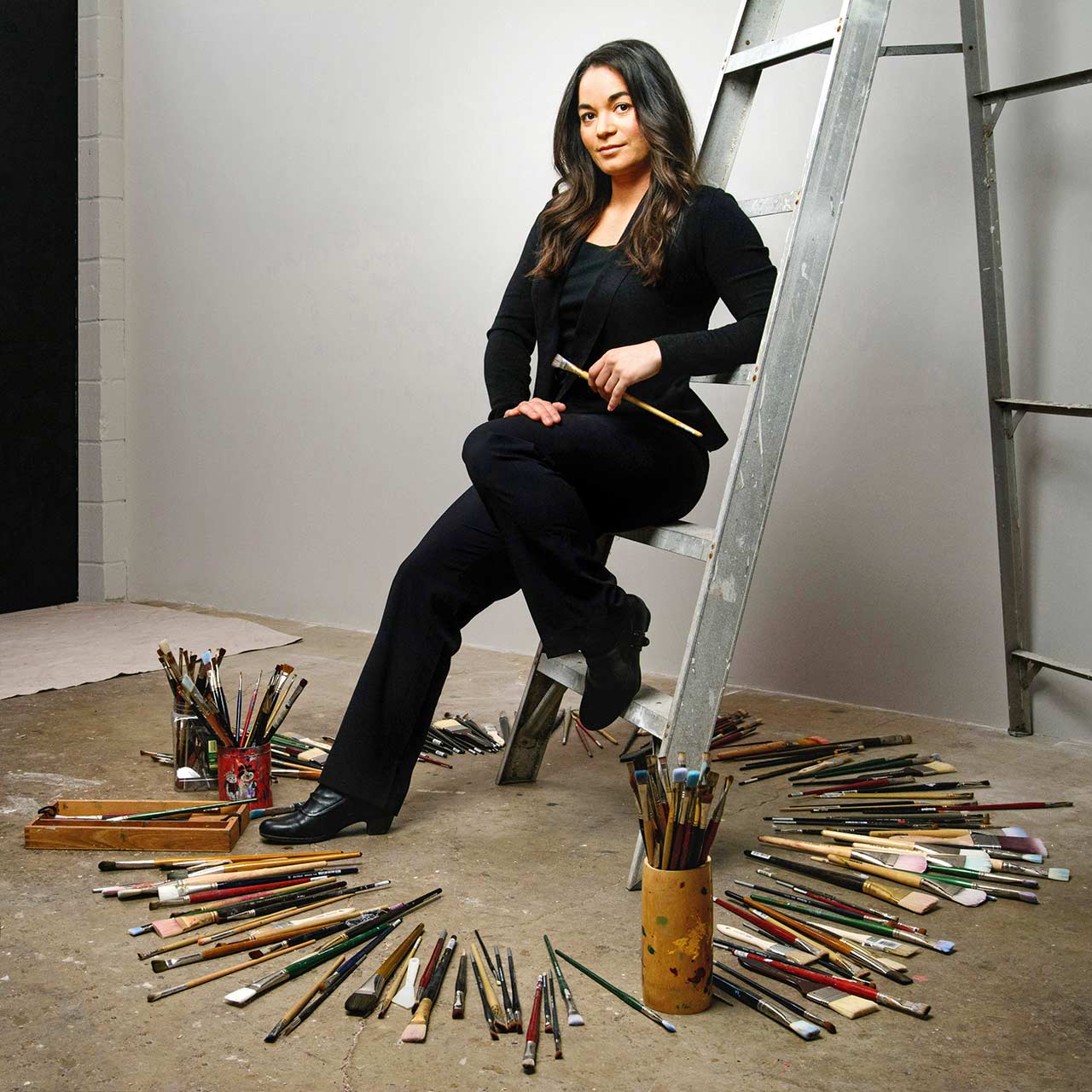
Erin Hanson’s relationship with painting began remarkably early. She started working in oils at eight, took commissions by ten, and by twelve was apprenticing at a mural studio, helping create enormous 40-foot canvases while continuing to develop her own artistic practice. Inspired as a child by the luminous color and light of artists such as Vincent van Gogh and Claude Monet, she developed an enduring fascination with painting’s ability to transform the ordinary into something extraordinary. Yet her path initially took an unexpected turn: after graduating from high school at sixteen, Hanson studied Bio engineering at UC Berkeley. Her passion for rock climbing, however, eventually brought her back to painting. While exploring the dramatic landscapes of Red Rock Canyon in Nevada, she found herself captivated by the angular formations, intense colors, and constantly changing desert light.
In 2006, during her first days in Las Vegas, a plein-air painting made at sunrise became the foundation of what would later evolve into her signature style, Open Impressionism.
Combining the influence of classical Impressionism with a more contemporary, expressionistic approach, Hanson developed a distinctive language of bold color, thick impasto, and loose brushwork. Rather than blending layers of paint, she places expressive strokes side by side, working with a deliberately limited palette to preserve the clarity and vibrancy of each color.
Her landscapes are not literal reproductions of nature; instead, they seek to communicate the emotional experience of being immersed in it—the movement of light, the rhythm of a landscape, and that fleeting moment when an ordinary scene becomes breathtaking.
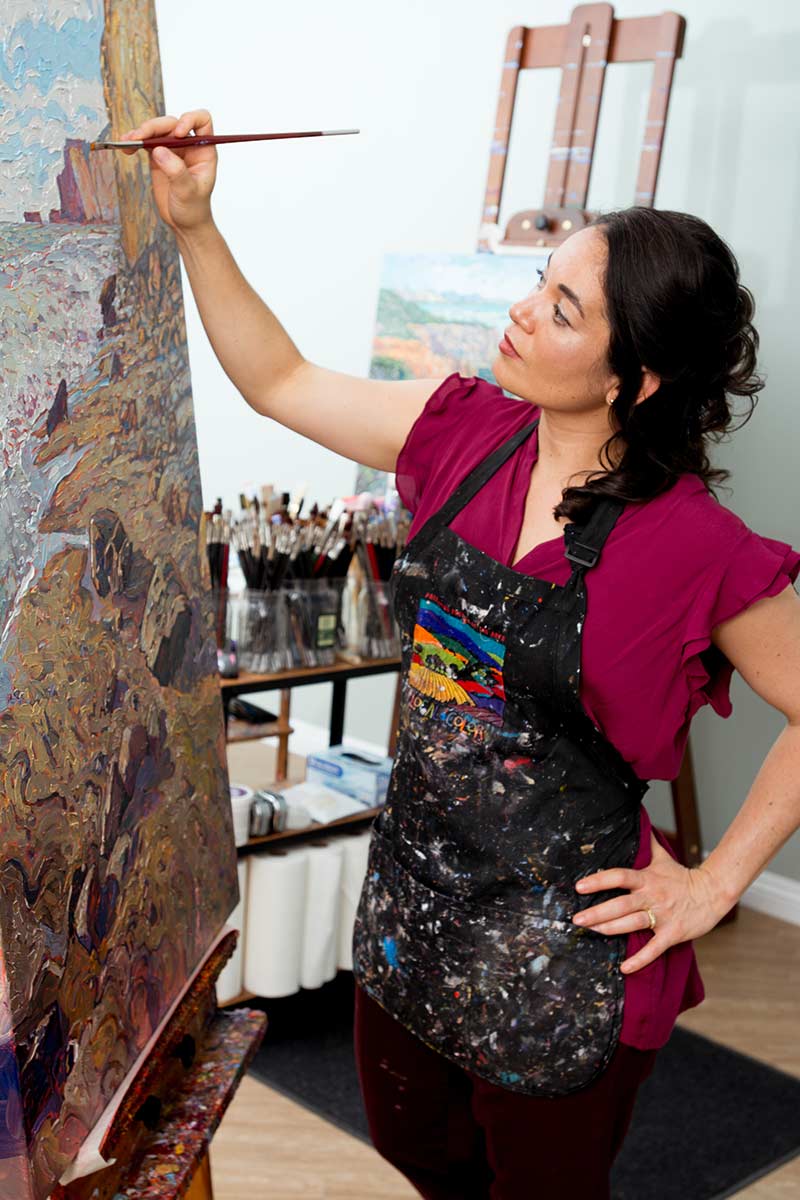
For Hanson, painting and exploring nature have always been inseparable. Her travels through national parks, deserts, mountains, coastlines, wine country, and more recently Japan, France, and Norway provide an ever-changing reservoir of visual experiences. Working from thousands of photographs gathered during these journeys, she transforms fragments of real landscapes into highly expressive compositions, carefully selecting what to emphasize and what to leave to the viewer’s imagination. Alongside her own prolific practice, she has devoted considerable energy to encouraging other artists to pursue their creative careers independently, sharing the belief that it is possible to build a sustainable life around art. Today, Open Impressionism has become not only the defining language of Hanson’s own work, but also a contemporary approach embraced and taught by artists around the world.
Over the past several years, Erin Hanson’s distinctive vision has been presented in a series of significant museum exhibitions across the United States. In 2025, her work was featured in Fistful of Colors at Western Spirit: Scottsdale’s Museum of the West, following her 2024 solo museum exhibition Landscapes of the West at the Sears Art Museum at Utah Tech University in St. George, Utah, where thirty paintings celebrated the landscapes of southern Utah and the Colorado Plateau. Her recent museum exhibitions also include The Color Show at the Channel Islands Maritime Museum in Oxnard, California, and Colors on the Vine at the Bone Creek Museum of Agrarian Art in Nebraska, both in 2023.
Her work is also represented in the permanent collection of the Hilbert Museum of California Art, among other museum collections across the United States.
“My goal for each painting is to capture a moment in time so beautiful it makes you catch your breath when you see it. I want my paintings to speak to you again and again, drawing you in, igniting a sense of joy every time you look at them.”
– Erin Hanson
© All rights reserved
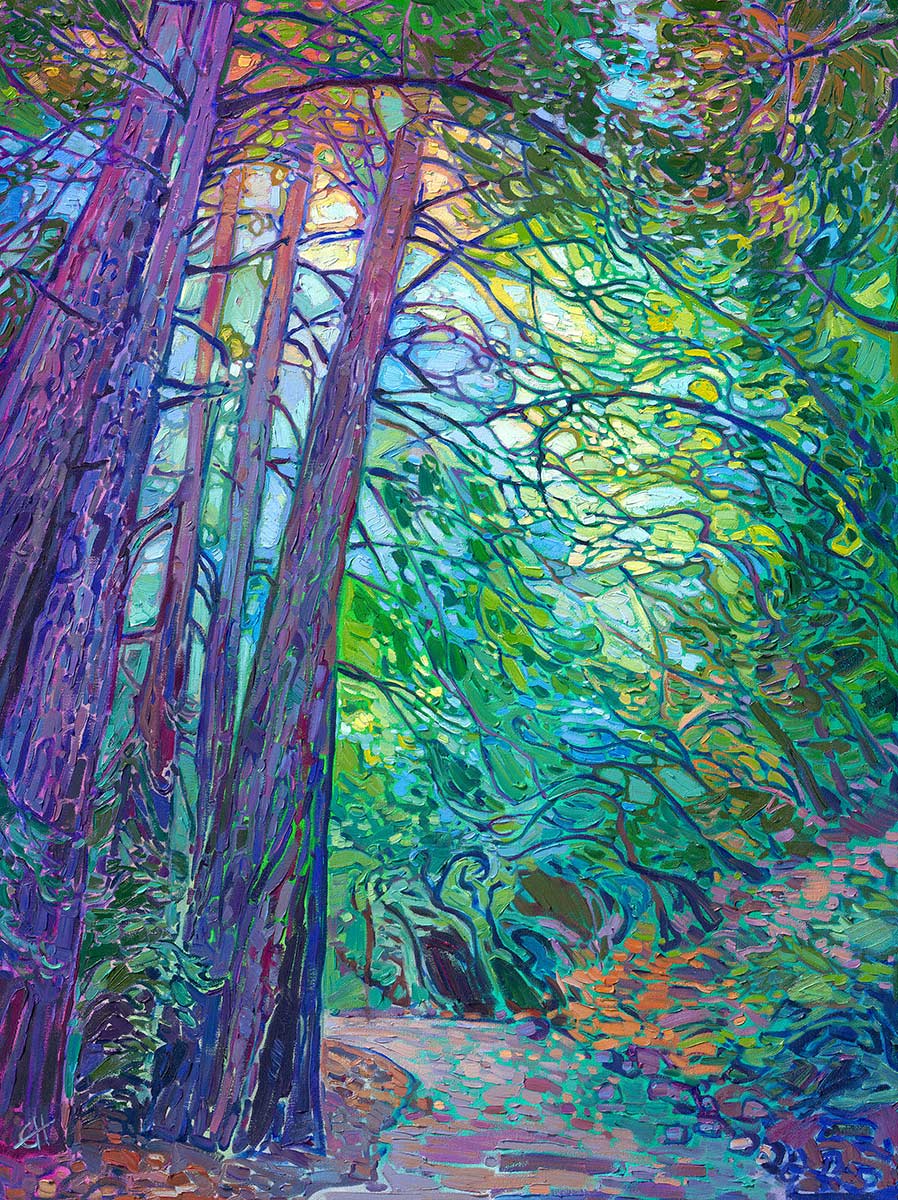
Right: “Lighted Redwoods”. 2023
Oil on canvas, 101 x 76 cm
Erin Hanson © All rights reserved
An Exclusive Interview With Erin Hanson
Art Market Magazine: Dear Erin, It’s a pleasure to feature an interview with you. Thank you for taking the time to share your artistic journey with our readers. Let’s start from the beginning. Did you grow up in an artistic environment?
Erin Hanson: My parents are not painters, but they are classical musicians. I grew up in an environment where the mantra “practice makes perfect” felt second nature. As a kid, I was told that if I wanted to grow up to be a painter, I should do five life sketches every day. We were also big into reading as a family (I was raised without screens).
I remember my parents and my three brothers all reading around the dinner table every night, until my dad finally made a rule that on Fridays there was no reading at the table, and we had to talk to each other instead.
Art Market Magazine: You began painting in oils at just eight years old and were already selling commissions by the age of ten. Looking back, do you remember when you first realized painting wasn’t simply something you loved, but something you wanted to devote your life to?
Erin Hanson: I remember the moment I decided to throw all my energy and passion into painting. I was about nine years old, and my school went to an art museum, where I saw van Gogh’s Irises in person. I was enraptured with the painting, and I decided immediately that irises were my favorite flowers. Later, my mom was planting bulbs in the garden, and she asked me to help her to plant some irises.
I was over-the-moon excited—I was going to get to see my favorite flowers in full bloom!! I spent months eagerly awaiting the flowers’ arrival, and when they finally bloomed, I remember feeling so disappointed… they were just ordinary, small, bluish flowers. In that moment, I realized Van Gogh had taken an ordinary object and turned it into something magical and extraordinary, using only paint, a brush, and a blank canvas. I decided that I wanted to create magic like that.
Art Market Magazine: You studied bioengineering at UC Berkeley while continuing to develop as an artist. Your scientific and artistic interests may seem very different, yet you have described them as complementary. How has your scientific background influenced the way you observe nature, color, structure, or the world around you?
Erin Hanson: The most important lesson I learned from my degree in Bio engineering was that I could accomplish anything if I set my mind to it. To succeed as an artist, I had to develop a lot of technique, both as a painter and as a businesswoman. For example, I developed a method to scan and print my highly textured oil paintings as 3D Textured Replicas. I knew conceptually this should be possible, and I spent four years on trial and error until I perfected the technique. Now my collectors can own textured reproductions that are almost indistinguishable from an original oil painting.
My Open Impressionism technique is also a form of reverse engineering. I begin with a clear picture of what I want my painting to look like, aided by sketches. Next, I pre-mix my entire color palette from only five tubes of paint, creating every color that will appear in the painting, before I ever pick up a brush. When I finally start painting, I work alla prima (wet-on-wet) from dark to light, which means I have to hold the image of the finished painting in my mind and reverse-engineer it, starting with the darkest darks and moving into the light.
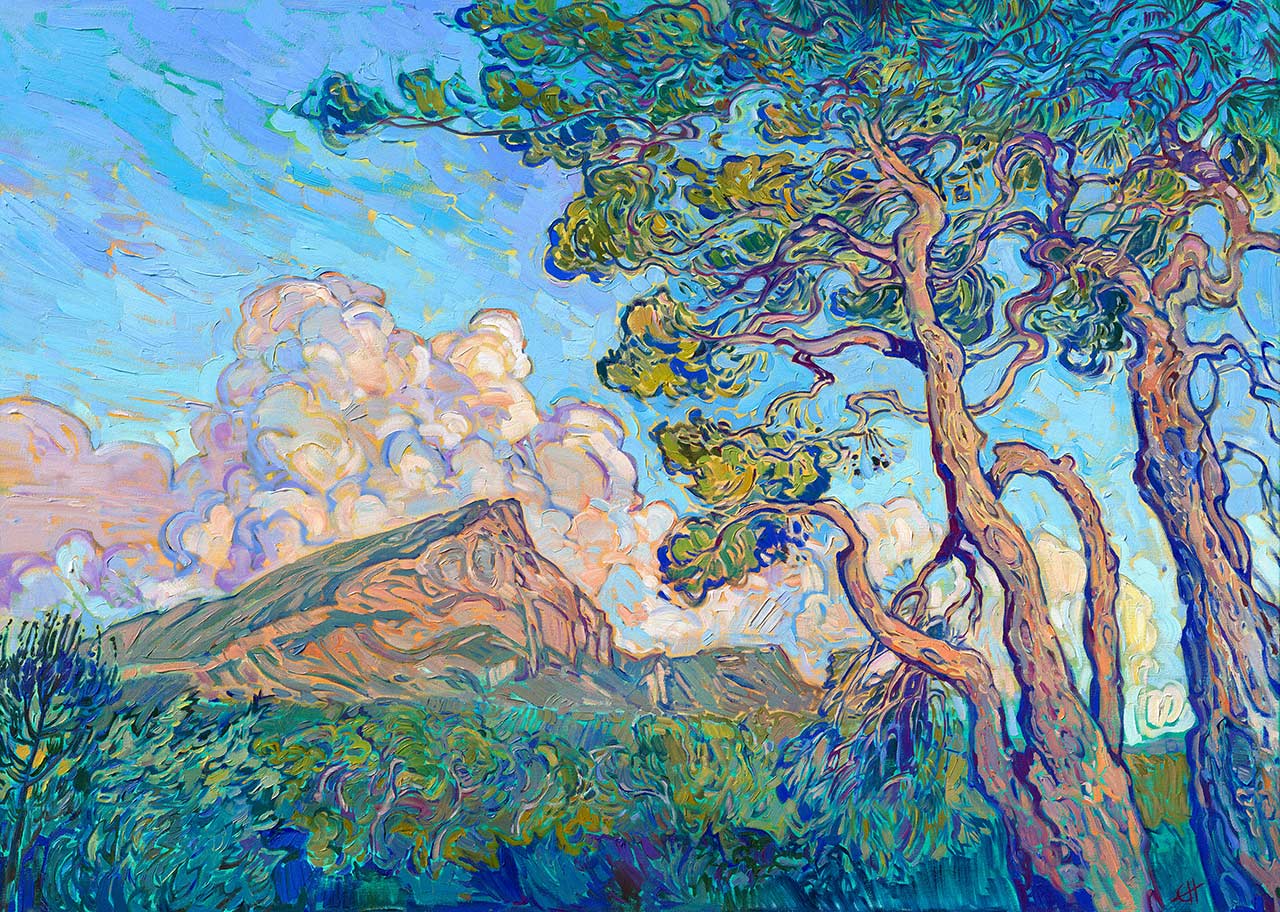
Oil on canvas,
102 x 142 cm
Erin Hanson © All rights reserved
Art Market Magazine: The birth of Open Impressionism is closely connected to your experience of arriving in Las Vegas and discovering the desert landscape around Red Rock Canyon. What did you experience in that landscape — and in that particular light — that made you begin painting differently?
Erin Hanson: I grew up in Southern California (Los Angeles), and all the inspirational moments that made me want to be a painter happened outdoors, while hiking, camping, or backpacking. So, when I discovered Red Rock Canyon in my early 20s, I was already primed to appreciate beautiful landscapes. And Red Rock Canyon was the most colorful and dramatic landscape I had ever seen at that time.
I woke up at dawn on my first morning in Las Vegas, and I created my first plein air oil painting of the canyon. The brilliant reds, pinks, purples, and oranges made me reach for all my rich cadmium colors—colors I never got to use painting California’s trees and mountains. I painted quickly to catch the early morning light before it faded, and I didn’t want my colors to get muddy, so I kept my brushstrokes separate on the canvas. This was the birth of Open Impressionism.
“When I started trying to sell my work at art festivals, I noticed a deep, desperate need for people to surround themselves with beautiful things.
Art lets people share and remember life’s beautiful and poignant moments.”
– Erin Hanson
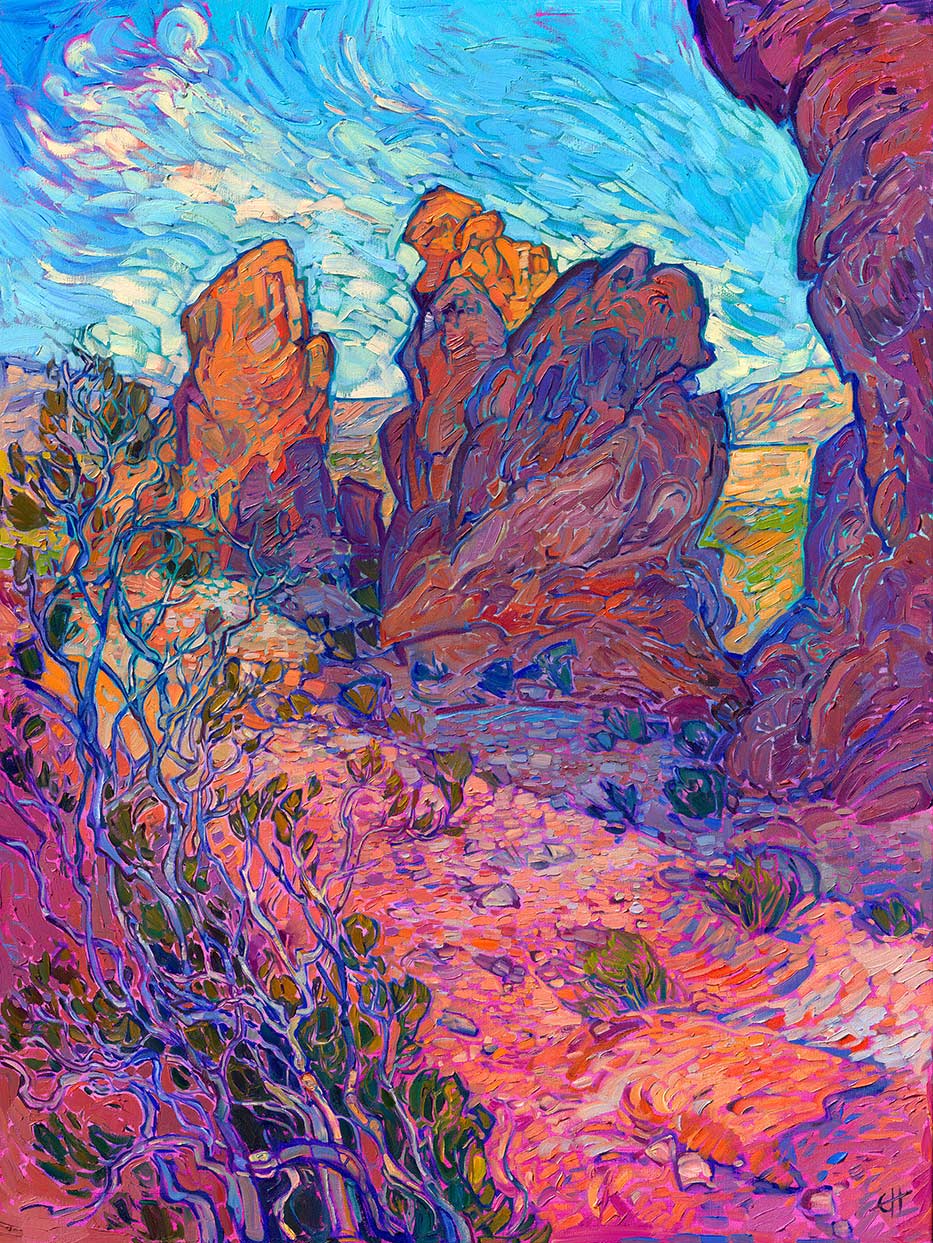
Oil on canvas, 122 x 91 cm
Erin Hanson © All rights reserved
Art Market Magazine: You coined the term Open Impressionism to describe your approach to painting. When did you realize you had moved beyond developing a personal style and created a distinct visual language of your own?
Erin Hanson: It was about 400 paintings before I decided that my style was unique and different from anything else I’d seen people paint. After several hundred paintings, I felt like my paintings were turning out the way I wanted them to: capturing the light and vibrant color of the desert landscapes I was painting.
When I moved back to California and started painting oak trees and rolling hills, my blocky rock-painting techniques traveled with me, and I could capture the idyllic landscapes of Paso Robles and Monterey just as easily as I had captured the Colorado Plateau.
Art Market Magazine: One defining characteristic of your work is your use of thick, expressive brushstrokes placed side by side without blending. What does this approach allow you to express that traditional blending cannot?
Erin Hanson: When I took up painting again as an adult, it was very important to me that painting be FUN. I wanted to paint in a free and flowing manner, where you could see all my brushstrokes and my finished paintings would look like they just came spontaneously into existence. Well, it turned out that the only way I could be free and spontaneous when painting was to do a lot of planning before I ever picked up a brush. By preparing the composition and color plan, I could place my brushstrokes exactly and get them “right the first time.” The result was those beautiful brushstrokes and texture that I love so much about paintings. You know you are looking at a painting when you see one of my works.
Art Market Magazine: You work with a remarkably limited palette of only four or five pigments, yet your paintings contain an extraordinary range of color. What does working within this limitation give you creatively?
Erin Hanson: Using a limited palette began as a way to avoid a muddy palette, but it became a source of freedom and a way to express my love of color. I found through experience that I could create a much wider variety of colors by sticking to a few high-quality primaries than by buying pre-mixed tubes. Pre-mixed colors might look beautiful on their own, but they generally don’t mix well together, since each tube of paint might contain three or more pigments. When you blend “tree sap green” with “orange bisque”, you don’t get a beautiful blended color—you get a muddy gray caused by mixing six or seven pigments.
Art Market Magazine: You have described your goal as capturing “the beauty of light during the golden hour” and transforming ordinary landscapes into extraordinary mosaics of color and texture. When you begin a painting, what comes first for you: the landscape itself, the light, the color, or the emotional response you had to the place?
Erin Hanson: A moment of inspiration always happens before every painting I have ever done. The moment happens outside in the natural world (or mostly natural), and it is always a combination of the landscape’s abstract forms, color, light, and my emotional response to the whole. I feel a tight feeling in my chest and a driving desire to capture this transient moment of beauty on my canvas. With each painting I begin, I have fresh hope of creating a piece that stops other people in their tracks and makes them feel the same emotional joy I felt when I first saw the landscape.
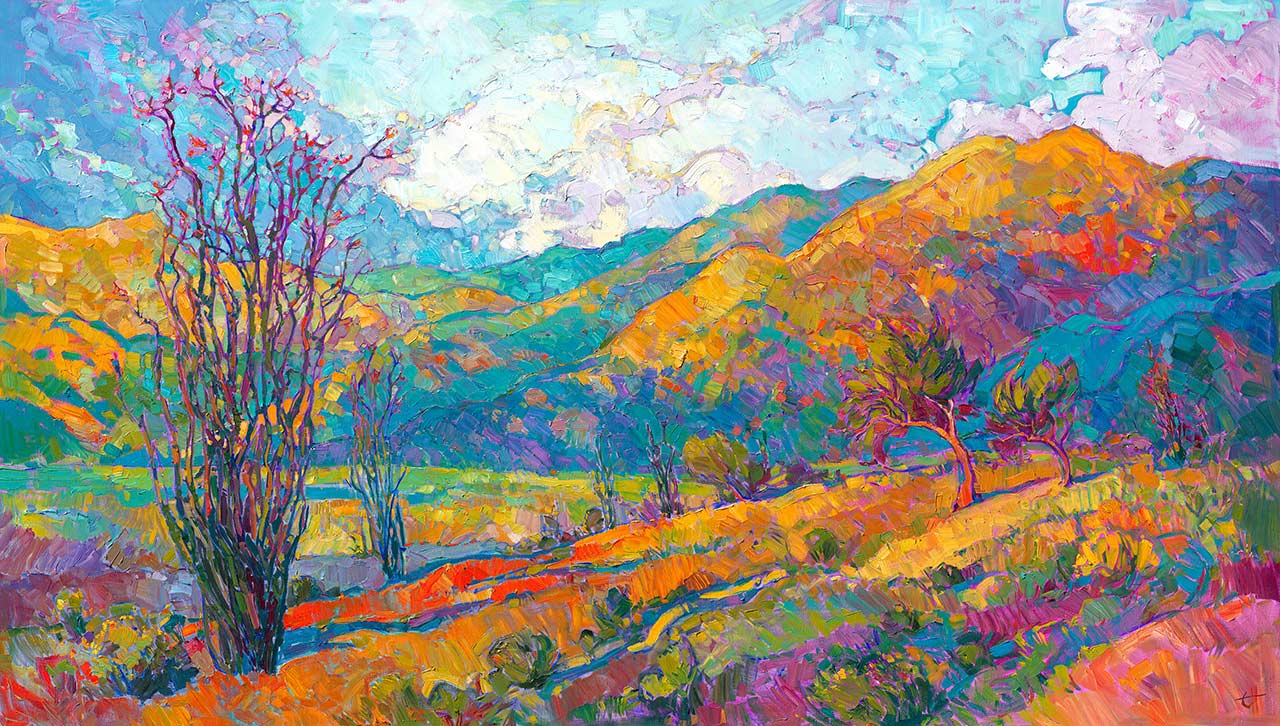
Oil on canvas,
122 x 213 cm
Erin Hanson © All rights reserved
Art Market Magazine: Nature is clearly more than a subject in your work. You have spent years hiking, backpacking, climbing, and exploring some of the most remarkable landscapes in the American West and beyond. What are you looking for when you enter a landscape with your camera or sketchbook?
Erin Hanson: When I go outside looking for inspiration, I look for abstract shapes created by mountains, trees, cliffs, grass, light, and shadow that let me capture the landscape’s beauty on canvas. Have you ever been to the Grand Canyon? Every time I go, I see thousands of people out taking photos and enjoying the canyon at high noon. With our eyes, we can judge distance and color and see beauty in the natural world. However, as a painter, this is not good enough.
I have to use shadows and visually distinct color values to communicate and capture depth on a flat canvas. This means I must photograph landscapes during the golden hour, when the sun is low on the horizon and casts long shadows across the landscape. Even then, I have to angle my position so I can see the shadows and ensure their placement, as abstract forms will communicate three-dimensional form correctly when I paint. I spend more time focused on shadows when planning and composing paintings, since without shadows, there is no light.
Some compositions don’t require golden-hour light, such as cherry blossoms or fall-colored leaves against a blue sky. Here, the art of composition comes from artfully placing branches against a flat sky.
Art Market Magazine: You work extensively from photographs gathered during your travels, rather than simply reproducing a single scene directly onto canvas. How do you preserve the feeling and atmosphere of actually being in the landscape when you return to the studio?
Erin Hanson: I rarely take a photograph that is a perfect composition all on its own.
This is partly because of the nature of cameras: the lens shrinks distant objects and enlarges closer ones. However, if you stand in front of a huge mountain peak, its sheer size overwhelms the senses. A camera can never recreate this, so I have to magnify and “distort” the photograph to return it to the original glory I experienced in person. Sometimes I will use a zoom lens to capture the majesty of the distant object, and then use a regular lens to photograph the foreground, and I work from both photos when painting in my studio.
Art Market Magazine: Your Crystal Light series pushed your exploration of light and color toward almost prismatic, mosaic-like compositions. What did this series teach you about painting that you carried into your later work?
Erin Hanson: My first Crystal Light painting was an experiment in exaggerating shadow lines and distinct planes of illuminated color. The result created an unexpected prismatic effect that captured, to me, what it really felt like to observe this scene in nature. I started experimenting further with this radiating light effect, and it became one of the tools I use to capture nature’s beauty.
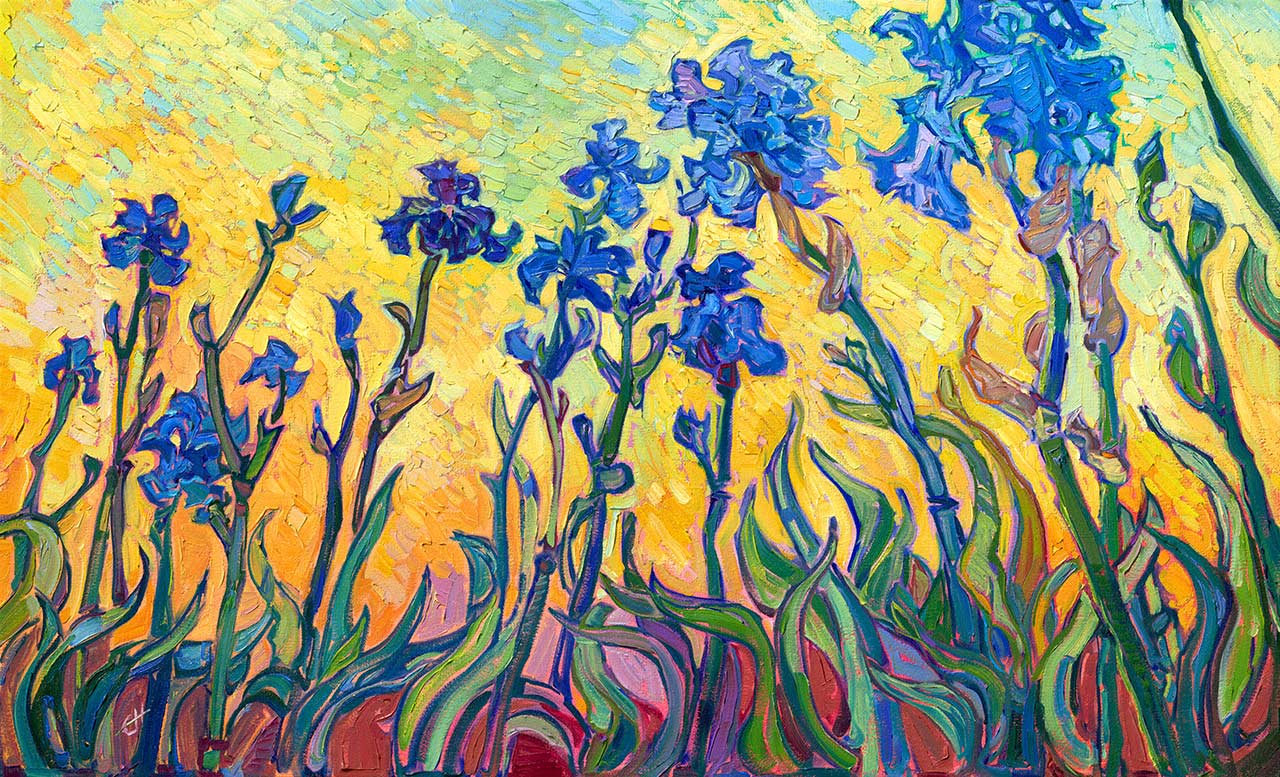
Oil on canvas,
56 x 91 cm
Erin Hanson © All rights reserved
Art Market Magazine: You have built a remarkably independent career while also encouraging other artists to find sustainable ways to make a living from their work. Why has supporting and educating other artists become such an important part of your own journey?
Erin Hanson: When I was a teenager, I worked in a mural studio with a team of adult artists, and every one of them took me aside at some point and told me that it was too hard to make a living as an artist, and that I should do something else with my life. Someone in their life has told every artist I have ever spoken to that painters can’t make a living painting. In every television show and movie about painters, they are usually struggling and unpaid. Yet when I started trying to sell my work at art festivals, I noticed a deep, desperate need for people to surround themselves with beautiful things. Art lets people share and remember life’s beautiful and poignant moments. At the first festival I ever did, I sold six paintings for $500 apiece, and since then I have sold over 3,500 original oil paintings. Half my paintings sell before they are even dry on the racks.
All this tells me that it is a complete fallacy that artists can’t make a living making beautiful art. And so, I want to share my success story and encourage other artists to try making a living doing what they love. Unfortunately, art schools don’t teach the business of being an artist. I have heard thousands of sad stories of artists graduating with a degree and immediately needing to take a “day job” or turn to graphic design, because they don’t have any collectors and don’t know how to sell and market their work.
I want to help create a future where a kid tells his parents he wants to be an artist when he grows up, and his parents almost faint with joy, relief, and the certainty that he will be taken care of in old age.
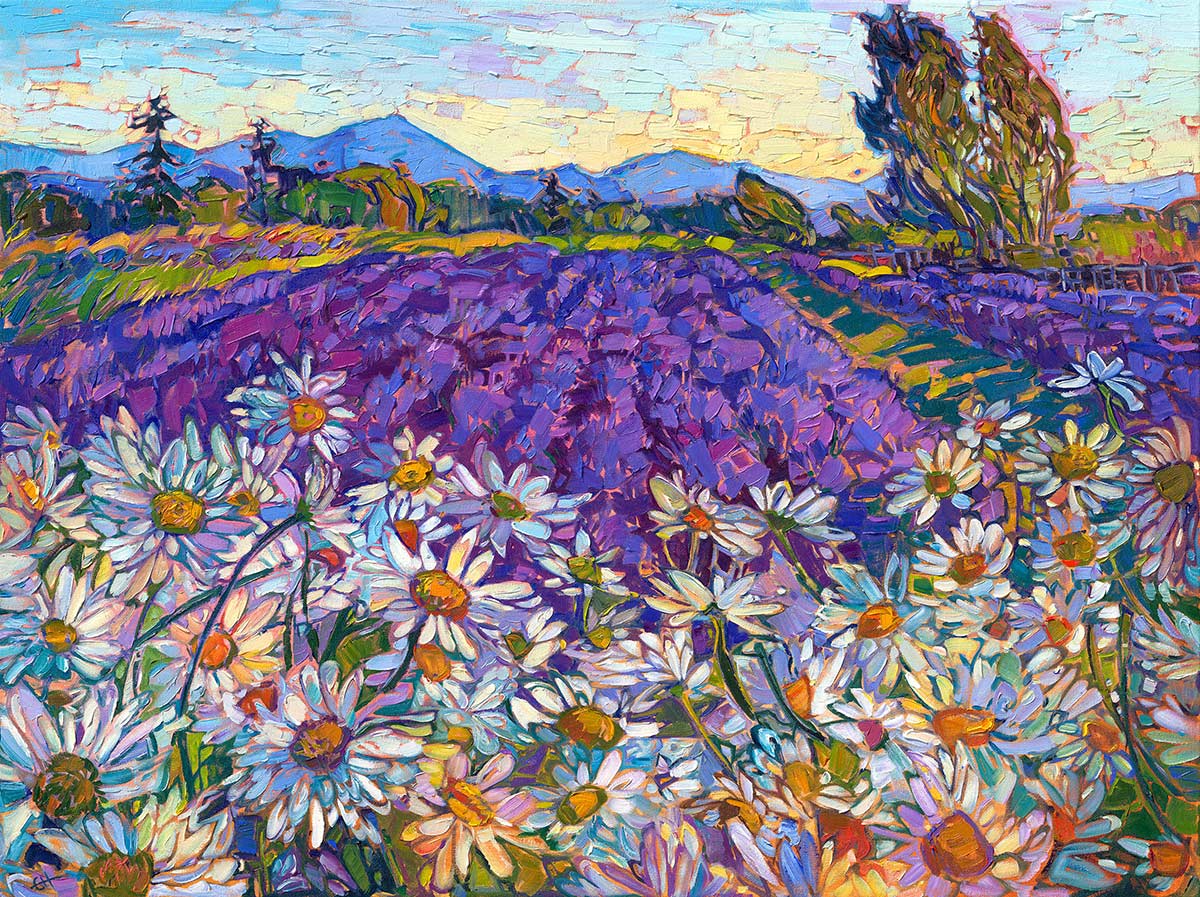
Oil on canvas,
76 x 102 cm
Erin Hanson © All rights reserved
Art Market Magazine: Your paintings are often experienced first as luminous landscapes, but when viewed closely, the individual brushstrokes become almost physical objects of color and texture. What do you hope happens to the viewer when they move from seeing the whole landscape to discovering these individual marks?
Erin Hanson: To me, Impressionism is about taking random, apparently disconnected brushstrokes and colors and somehow merging them together so they resolve into a form when you see them from a distance. I love seeing Monet’s Haystacks up close, seeing all those little lines of various colors, and then stepping back and seeing the luminous light and forms that appear. I hope viewers see my abstract blobs of paint up close like individual mosaic tiles or pieces of a stained-glass masterpiece, which only takes on three-dimensional form when seen from several feet away.
Art Market Magazine: You have spent your life looking closely at the natural world, searching for those fleeting moments when light transforms a landscape. After decades of painting, has your art changed the way you experience nature itself — and what still makes you stop and catch your breath?
Erin Hanson: Absolutely—I experience nature through the eyes of an artist: constantly creating compositions and analyzing color every time I look at a natural landscape. Living in Oregon wine country, I am surrounded by beautiful scenery, and every day I am composing new paintings from my surroundings. A recent painting I created, Scarlet Poppies, was inspired by a little patch of red poppies that I kept driving by on my way to work. One day, I stopped and photographed them, and I ended up painting an enormous 9-foot painting of the red blooms.
When I go on photo safaris to capture images for my paintings, I photograph landscapes exclusively during the golden hours (early morning and sunset). Golden hour light is more colorful, saturated with warm hues, and the side lighting makes the landscape appear to have depth and form in two dimensions when I look at photo references.
What makes me stop and catch my breath? Unusual trees, stunning color, unexpected hues, and monumental landscapes that overwhelm me… like seeing Mt. Rainier up close after the cloud cover parted suddenly, or seeing the endless fields of lavender on the high plateaus of Provence, or seeing the turquoise waters against white swirling waves of the Pacific Ocean… I am endlessly catching my breath from the unexpected beauty that nature provides.
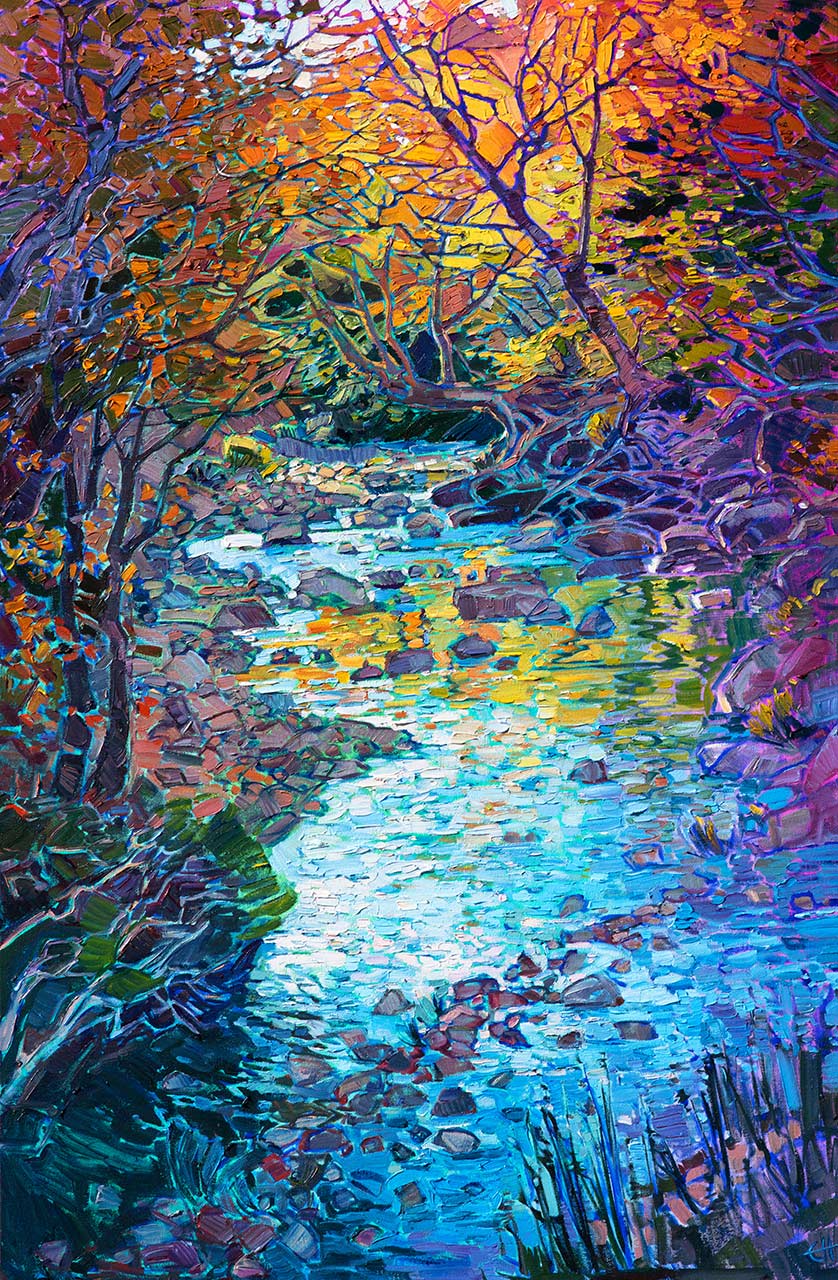
Oil on canvas,
101 x 66 cm
Erin Hanson © All rights reserved
Art Market Magazine: After a lifetime of professional experience, extensive exhibitions in galleries and museums, international awards, and published books, what advice would you give to young artists who want to build an independent presence in today’s art market?
Erin Hanson: I believe any artist can build a successful career by doing outdoor art festivals. Festivals let you take your career into your own hands, without needing permission from galleries or other “authorities.” You can find a market for collectors who love exactly what you are painting (instead of trying to paint what you think will sell), which is very satisfying as an artist. I personally know hundreds of artists who make a living doing art festivals, and they support themselves and their families while creating what they love and are passionate about.
The Erin Hanson Gallery
1805 NE Colvin Court
McMinnville, Oregon 97128
(503) 334-3670
Website: www.erinhanson.com
Instagram: @erinhansonartist